
Justin's insights have been featured in


A Personal Note to Financial Advisors Planning 2027
I could have recorded a long video for this page, but I can say it in two sentences.
Most January plans are dead by March, and discipline is rarely the reason. They die because nobody broke them down into who does what, by when.
On December 1, I'll walk you through the exact process my members use, and you'll leave with your 2027 mapped.
Justin
Your 2027 will happen either way.
The only question is whether you plan it or it plans you.
Every fourth quarter looks the same for most financial advisors. Year-end reviews, RMDs and tax-loss harvesting fill the calendar. The planning you meant to do in November slides into December. Then January 2 arrives, your team looks to you for direction, and the plan gets built on the fly in your head.
A goal without a breakdown
You know the number you want for 2027. What's missing is the path from that number to what your team does on Monday morning.
Too many priorities at once
A new hire, a marketing push, a tech migration and a succession conversation all compete for the same quarter. When everything is a priority, none of them gets finished.
A plan only you can carry
Your team keeps executing last year's priorities while next year's live in your head. A practice that runs on what you remember is a job, not a transferable asset.
Why most January plans are dead by March.
The annual retreat
It produces a whiteboard full of ideas and a SWOT nobody looks at again, because no idea was assigned to a person with a deadline.
The downloaded template
It gives you boxes to fill in, but it doesn't tell you which 3 things matter most or how to break them down.
Planning alone
Planning between client meetings means the plan competes with the work it was supposed to organize, and the client work always wins.
The financial advisors who grow enterprise value don't write longer plans. They choose 3 objectives and break each one down until every step has an owner and a date.
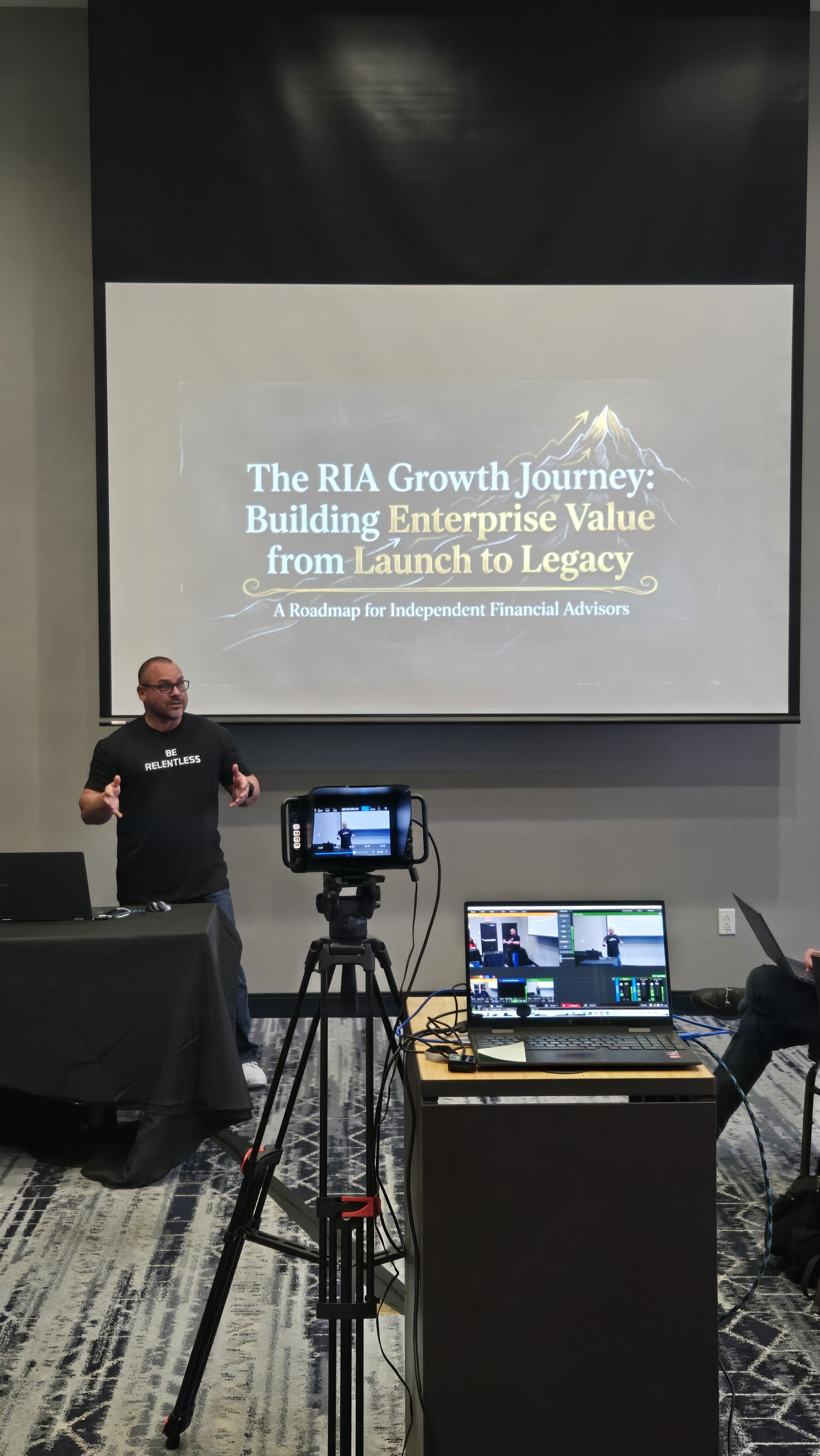
Here's what happens on December 1.
This isn't a lecture about goal setting. You'll map your own 2027 alongside Justin, one phase at a time, with your workbook open.
Your numbers, first
Only 3 financial advisors get this hour, and it sells out every time. Justin works through your current-year numbers with you, so the SWOT you build at 2:00 starts from what actually happened in 2026. With 3 seats, your questions get real time, not a turn in a queue.
Set your North Star
Write the 5-year vision line for your practice and check your values against it. These rarely change, and everything after them changes every year.
Assess where you stand
Run a timed SWOT on your own practice. Then watch Justin take a single point from the assessment RVC members use and show you what it looks like ten layers deep.
Choose 3 objectives, and only 3
Set your 2027 revenue goal and 3 annual objectives, exactly 1 of them financial. Justin explains why three is the limit.
Watch the 3-9-27 breakdown
Justin takes 1 sample objective and breaks it into tactics and action steps live, each with an owner, an outcome and a deadline. Then he shows the math for your whole year: 3 objectives, 9 tactics, 27 assigned steps.
The rhythm that keeps it alive
The 1-4-12-52 meeting cadence: 1 annual planning session, 4 quarterly reviews, 12 monthly check-ins and 52 weekly meetings. December 1 is your 1.
Imagine walking into January 4 with the year already decided.
It's the first Monday of 2027. Your team already knows the 3 objectives, because they saw them in December. Nobody waits for you to tell them what matters this quarter, and nobody is still working on last year's priorities.
Your Monday meeting has a real agenda. Each action step has a name next to it, an outcome and a date. The meeting takes thirty minutes because everyone knows what they own.
A prospect calls who doesn't fit the clients you want to serve. You used to take the meeting anyway. Now you know in a minute whether that prospect moves one of your 3 objectives forward, and you decide from strength instead of fear of an empty calendar.
Over the holidays, your spouse asks what next year looks like. For once you don't say "busy." You can name the number, the 3 things that get you there and who on your team owns each one.
By midyear you know whether you're on pace, because the plan is measured instead of remembered. If you're behind, you know which objective slipped and you adjust it, instead of discovering in December that the year got away from you.
A written plan your team executes against is also one of the first things a buyer looks at. A practice that runs on a document instead of a person is a transferable asset, and transferable assets are worth more.
You stop being the plan. You become the person who wrote it.
What You Leave With on December 1
- Your 2027 North Star. A 5-year vision line for your practice, with your values checked against it.
- Your practice SWOT. Built on your own numbers, not a generic checklist.
- Your 2027 revenue goal and 3 annual objectives. Exactly 1 financial, the way Justin sets them.
- The 3-9-27 breakdown method. You watch Justin take 1 objective down to owners and deadlines, so you can repeat it on the other two.
- The 1-4-12-52 meeting rhythm. The cadence that keeps a plan alive after January.
- The 2027 Planning Workbook. Fill it in live as Justin teaches.
Members running the plan. In their own words.
"My first draft of it was 10 times better than what I had done on my own."
"Best year ever on all fronts. So excited about this year end and even more excited about how next year builds on this year's progress."
"After all the foundational work we've been doing together over the past 18 mo, I decided to take the assessment again and scored a 73... We've made a great deal of progress. Thank you!"
"Finished core values, mission and vision. Currently reviewing what I have. Just had a massive Q3, should turn out to be my best ever."
Two ways in. Only 3 VIP seats.
- VIP Hour with Justin at 1:00 PM ET, working from your current-year numbers
- 2-hour live workshop on Zoom
- 2027 Planning Workbook
- Your questions answered first
- Limited to 3 financial advisors. VIP sells out every time.
- 2-hour live workshop on Zoom
- 2027 Planning Workbook
Run the numbers before you decide.
Say 1 of your 3 objectives for 2027 is bringing on 5 new ideal clients. If each one pays you $4,000 a year and stays for 10 years, every client is worth roughly $40,000 over the relationship, before any market growth. Five of them is $200,000.
The question isn't whether two hours is worth it. The question is whether you want those 5 clients to be an objective with owners and deadlines, or a hope you revisit next December.
This is about more than a plan.
A plan that only you can carry keeps you in the middle of every decision. A plan your team owns lets you step back from the day-to-day and lead the practice instead of running every part of it.
You'll leave December 1 with the first piece in your hands, and a clear picture of what it takes to keep it alive all year.

Taught by someone who runs his own companies this way.
Justin isn't teaching a planning theory from a book. He's teaching the process he has used to run his own companies and the one RVC members use to run theirs.
He built his practice from zero to an eight-figure sale in 49 months. Today he spends one day a month in the business, because the business runs on a plan and a team instead of on him.
He has spent more than a decade coaching hundreds of financial advisors and business owners. He credits Patrick Lencioni's work as the root of the process, and he wrote the full framework into his book, Your Baby's Ugly.
- Wall Street Journal bestselling author of Your Baby's Ugly
- 5-time Investopedia Top 100 Most Influential Advisor
- 2022 Peter Christman Exit Planner of the Year
- 2024 Exit Planning Hall of Fame, youngest inductee
- Host of the DecaMillionaire Decoded podcast
Before you save your seat.
What if I can't make it live on December 1?
I've done strategic planning before. How is this different?
Will this work if I don't have a team yet?
What's the difference between VIP and General Admission?
You already know what 2027 could be.
You wouldn't have read this far if you hadn't thought about it.
You know the number you want. You know a plan that lives in your head won't survive a busy first quarter. You know your team can carry far more if they can see the plan.
The question isn't whether you need a plan for 2027. The question is whether you'll decide it on purpose in December or let it happen to you in January.
December 1 is when you decide.